
In 1931, Kurt Gödel published a short paper that permanently changed what mathematicians and philosophers could reasonably expect from formal mathematics. Nearly a century later, the results still get summarized in slogans. Math cannot prove everything. Every system has limits. Truth outruns proof.
Those phrases point in the right direction, yet they flatten the real story. Gödel did not argue that mathematics collapses or that proofs stop working. He showed something more precise and more unsettling.
Any formal mathematical system that plays by reasonable rules and is strong enough to express basic arithmetic will necessarily fail to answer some questions it can clearly state. The system will also fail at something that once seemed central to the foundations of math, proving its own consistency using only its internal rules.
We prepared an explanation of what Gödel actually proved, how the proofs work at a conceptual level, what mathematicians mean when they talk about blind spots, and why the theorems still shape modern mathematical practice. Let’s begin.
What Formal Math Means In Gödel’s Setting
Gödel’s results apply to formal systems, not to informal mathematical reasoning or human intuition. A formal system is a carefully defined setup with three core parts:
The word mechanical matters. Proofs in a formal system are finite sequences of symbols that can be checked step by step without creativity or interpretation. If a proof is valid, a machine could verify it.
In Gödel’s framework, a statement counts as provable only if it can be derived using those rules. Human insight, diagrams, and plausibility arguments do not enter the definition.
Two properties of such systems sit at the center of Gödel’s work.
Consistency
A system is consistent if it never proves a contradiction. In practical terms, it does not prove both a statement and its negation. Once contradictions appear, every statement becomes provable, which destroys meaning.
Completeness
A system is complete if every statement expressible in its language can either be proved or disproved within the system.
or more practice with mathematical foundations and problem solving, sites like Qui Si Risolve provide detailed theory and solved problems in analysis and logic.
Gödel’s first incompleteness theorem shows that for a wide class of systems, consistency and completeness cannot coexist.
Why Arithmetic Is The Critical Trigger
Gödel’s theorems do not apply to every logical game or symbolic toy. They apply once a system can express a basic amount of arithmetic involving natural numbers, addition, and multiplication.
A canonical example is Peano Arithmetic, often abbreviated as PA. Stronger foundations, such as Zermelo–Fraenkel set theory with the Axiom of Choice also contain arithmetic and therefore fall under Gödel’s scope.
Arithmetic matters for one deep reason. Arithmetic can encode computation.
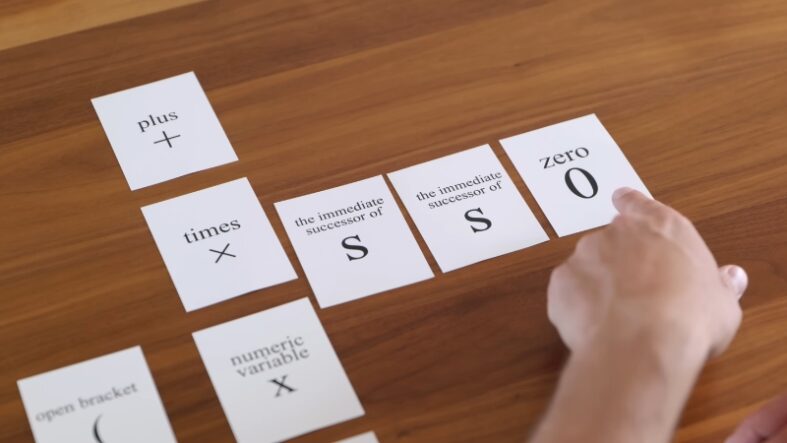
Once a system can reason about numbers in enough detail, it can encode statements about symbol strings, proofs, and algorithms by representing them as numbers. That bridge allows the system to talk about its own sentences using arithmetic language.
Self-reference enters through mathematics itself, not through philosophical trickery.
Gödel’s First Incompleteness Theorem
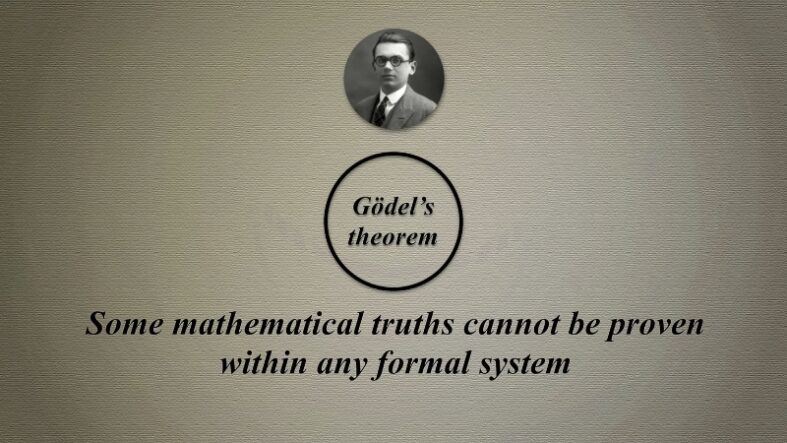
For any formal system that is consistent, effectively axiomatized, and strong enough to express basic arithmetic, there exists a statement that the system can neither prove nor disprove.
Effectively axiomatized means the axioms can be listed by an algorithm. There is no oracle or intuition required to identify them.
The result does not depend on sloppy definitions or vague reasoning. It follows from the structure of formal proof itself.
What “Blind Spot” Means In Practice
The phrase blind spot often invites misunderstanding. The theorem does not say the system makes arithmetic mistakes. It does not threaten results like 2 + 2 = 4 or standard algebraic identities.
The blind spot is structural. The system can formulate meaningful arithmetic statements that its own rules cannot resolve.
In many presentations, the undecidable statement Gödel constructs is true in the standard interpretation of the natural numbers, assuming the system is consistent. Yet truth and provability come apart. The system cannot certify that truth internally.
How The First Theorem Works Without Handwaving
View this post on Instagram
Gödel’s original proof is technical, but its core architecture can be explained cleanly. Three ideas carry the weight.
Gödel Numbering: Turning Syntax Into Numbers
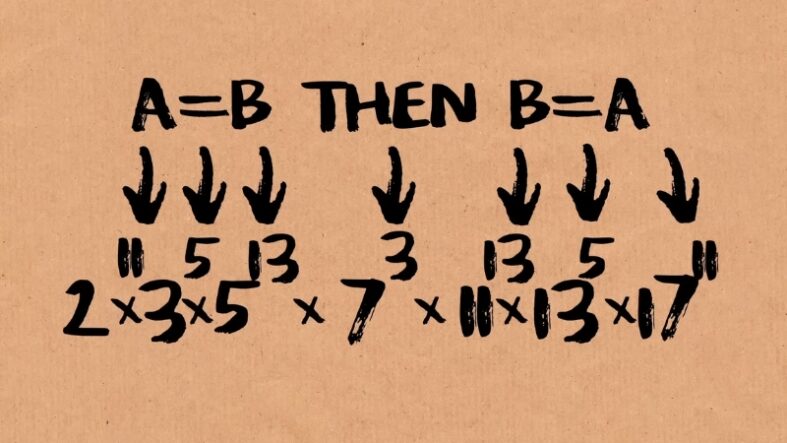
Gödel assigned each symbol, formula, and proof a unique natural number. Once that encoding exists, statements about formulas become statements about numbers.
One simple intuition uses prime factorization. Each symbol receives a code. A sequence of symbols becomes a product of primes raised to specific powers. Different sequences yield different numbers.
The details vary, but the principle remains stable. Syntax becomes arithmetic.
Representing Provability Inside Arithmetic
Next, Gödel showed that the property “x is the Gödel number of a valid proof of statement y” can itself be expressed as an arithmetic predicate.
Proof checking is mechanical. A system that is effectively axiomatized can recognize valid proofs using an algorithm. Arithmetic can encode that algorithm.
As a result, the system gains the ability to talk about its own proofs using number theory.
Diagonalization And Self-Reference
The final step constructs a statement that refers to its own provability. Modern presentations describe this using a diagonal lemma. Gödel’s original paper implemented the idea through explicit coding.
The resulting sentence, often called G, effectively says:
“This statement is not provable in the system.”
If the system proves G, it proves a statement claiming its own unprovability. That leads to contradiction under consistency assumptions.
If the system proves the negation of G, it asserts the existence of a proof that does not exist, again clashing with consistency.
So neither G nor its negation is provable. Incompleteness appears.
Rosser’s Refinement And Why It Matters
Gödel’s original argument relied on a technical assumption stronger than plain consistency. In 1936, J. Barkley Rosser refined the proof to remove that requirement.
Rosser showed that ordinary consistency alone suffices for incompleteness in systems like Peano Arithmetic.
The takeaway is practical. Incompleteness is not a fragile artifact of exotic assumptions. It arises naturally in standard foundational systems.
Gödel’s Second Incompleteness Theorem
No consistent formal system strong enough to express arithmetic can prove its own consistency using only its internal rules.
Inside such a system, one can formalize a sentence that means “there is no proof of a contradiction.” That sentence is often written as Con(T).
If the system could prove Con(T), it would violate Gödel’s second theorem, assuming the system is consistent.
Why Self-Consistency Proofs Fail Internally
The system can talk about proofs. It can encode the notion of contradiction. Yet the step of asserting “no contradiction exists here” exceeds what the system can justify from within itself.
David Hilbert created list of problems for the future of 20’th century mathematics, which is shaped mathematics. How a great university destroyed by Nazis infront of him both Physics and maths depts of Göttingen is one of the testimonial of how power corrupts acadamia. https://t.co/kdZxFoy26N
— sambaiah kilaru (@ksambaiah) February 12, 2026
That result blocked a central goal of early twentieth-century foundations, especially the vision associated with David Hilbert. Hilbert hoped for a complete, formalized mathematics that could certify its own reliability through purely formal means.
Gödel showed that once arithmetic enters the picture, that ambition cannot be met in full.
A Compact Comparison Of The Two Theorems
| Result | Typical Assumptions | What Exists | What The System Cannot Do |
| First Incompleteness | Consistent, effectively axiomatized, arithmetic-capable | Undecidable sentence G | Decide every statement |
| Second Incompleteness | Same regime | Formal consistency statement Con(T) | Prove its own consistency |
What Gödel Did And Did Not Say About Mathematics
Gödel’s theorems reshaped foundations, yet their scope is often overstated. Precision matters.
- Formal systems that are algorithmically defined
- Systems capable of expressing arithmetic
- Internal proof limits under consistency assumptions
- They do not show mathematics is unreliable
- They do not imply most statements are undecidable
- They do not guarantee humans possess access to all mathematical truth
The results separate truth from formal provability. They do not elevate human intuition into an infallible oracle.
Completeness, Decidability, And Common Confusion
Completeness in Gödel’s work refers to whether every statement or its negation can be proved inside a theory.
Decidability refers to whether an algorithm exists that can determine provability for every statement.
The two ideas are related historically but not identical. The early twentieth century featured intense study of both, including the Entscheidungsproblem, which asked for a general decision procedure for logical validity.
Gödel’s work sits alongside later results in computability theory. Together, they clarify the limits of mechanical reasoning.
Concrete Blind Spots In Mainstream Foundations
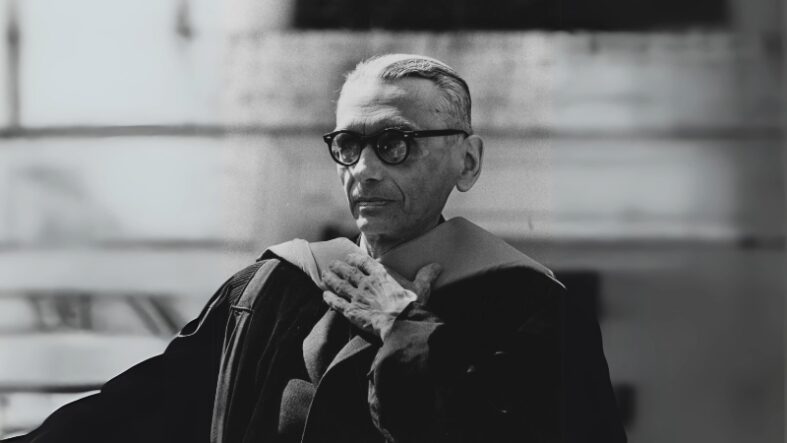
Even within the most widely trusted foundational systems, there are specific, well-defined statements that formal rules alone cannot resolve, revealing how Gödel’s limits surface in everyday mathematical practice.
Consistency Statements
The cleanest Gödel-style blind spot is a system’s own consistency claim. If the system is consistent, it cannot prove that fact internally.
To gain confidence, mathematicians step outside the system into a stronger framework or rely on relative arguments.
The Continuum Hypothesis
Set theory provides famous natural independence results. The Continuum Hypothesis, the first problem on Hilbert’s famous list, became a flagship example.
Gödel showed that CH cannot be disproved from standard axioms of set theory if those axioms are consistent. Decades later, Paul Cohen showed that CH cannot be proved either.
The result matches the incompleteness pattern. A powerful formal system leaves meaningful statements unresolved unless new axioms are added.
How Mathematicians Work With Blind Spots
Gödel’s results did not stall mathematical progress. They changed expectations.
Relative Consistency Proofs
Instead of proving absolute consistency, mathematicians prove relative consistency. If one theory is consistent, then another is consistent.
A landmark example comes from Gerhard Gentzen, who proved the consistency of Peano Arithmetic using methods that exceed what PA itself can formalize.
Adding Axioms Thoughtfully
When independence appears, researchers study the consequences of adopting new axioms. Set theory evolved into a field where different axiom systems are compared for strength, elegance, and mathematical fruitfulness.
Stable Cores Of Practice
Most working mathematicians live far from independence boundaries. Gödel’s theorems guarantee the existence of blind spots, not their prevalence in everyday proof practice.
Why Gödel Still Matters In A Computational Age
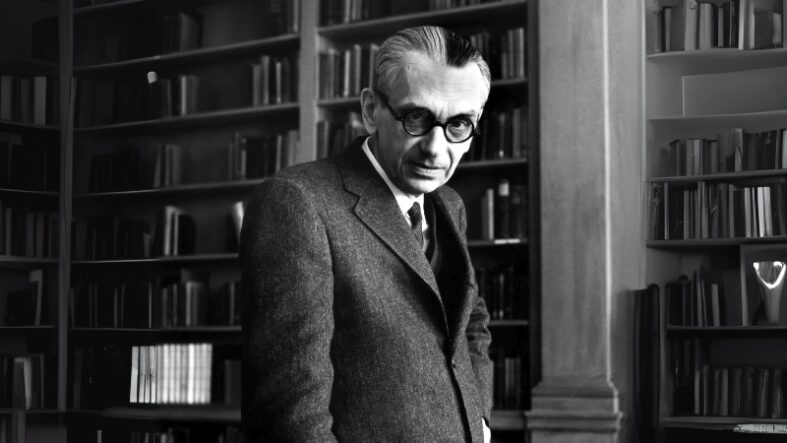
Gödel’s theorems remain relevant today because modern computation, automated proof systems, and formal verification still operate inside the same structural limits he identified nearly a century ago.
Limits Of Mechanical Proof
Any fixed, consistent, algorithmically defined proof system capable of arithmetic will miss some truths expressible in its language. No final automation settles everything.
Proof Assistants And Formal Verification
Modern proof assistants deliver remarkable reliability. They check proofs mechanically. Yet they still rely on foundational systems subject to Gödel’s theorems. Confidence comes from relative trust, small kernels, and layered verification, not internal self-certification.
Productive Constraint
Incompleteness motivates research into proof strength, minimal assumptions, and logical structure. Fields such as proof theory and reverse mathematics grew directly from the Gödel era.
Common Misconceptions Worth Retiring
The theorems describe formal limits, not metaphysical hierarchies.
A Precise Way To State The Blind Spot Story
@mitopenlearning What is Gödel’s theorem? 🤔 Keep exploring the intersection between philosophy and mathematics on MIT Learn: https://learn.mit.edu/search?resource=2809 #GodelsTheorem #Computers #Mathematics #Philosophy #STEM ♬ original sound – MIT Open Learning
Choose any formal mathematical system that is consistent, effectively axiomatized, and strong enough to express arithmetic.
Then two facts follow.
The system will contain well-formed statements that it cannot decide.
The system will lack the internal resources to prove its own consistency.
That combination captures what mathematicians mean by built-in blind spots. Formal systems powerful enough to speak about arithmetic are powerful enough to speak about themselves, and that self-reference enforces limits.
Gödel did not weaken mathematics. He clarified its architecture.